














How Budapest Became the Spa Capital of Europe
Budapest does not really announce itself as a spa city. You notice it gradually. A dome peeking above rooftops, steam rising from open-air pools in winter, grand entrances that feel more like palaces than bathhouses. Then it clicks. This is not a city with a few thermal baths. This is a city built on them.
What makes Budapest unique is not just the number of baths, but how deeply they are woven into everyday life. They are not attractions on the side. They are part of the city’s structure, shaped by geology, history, and culture that stretches across centuries.
A City Built on Hot Water
The foundation of Budapest’s spa culture is literally underground. The city sits on a network of thermal springs that naturally surface in multiple locations, especially on the Buda side. This is not something discovered recently or developed for tourism. It has been part of the landscape for thousands of years.

Photo by Book in Budapest
The Romans were among the first to recognize this, building bath complexes in the area of present day Óbuda. Later, during the Ottoman period, the tradition continued and evolved. The Turks introduced bath architecture that focused on domes, central pools, and a more meditative use of space. Some of these structures are still in use today, forming one of the oldest continuous spa traditions in Europe.
Ottoman Influence That Still Feels Present
The most direct link to this era can still be experienced at places like Rudas Baths and Király Baths. These baths keep much of their original architectural logic, with domed ceilings, subdued lighting, and water-centered layouts that prioritize atmosphere over decoration.
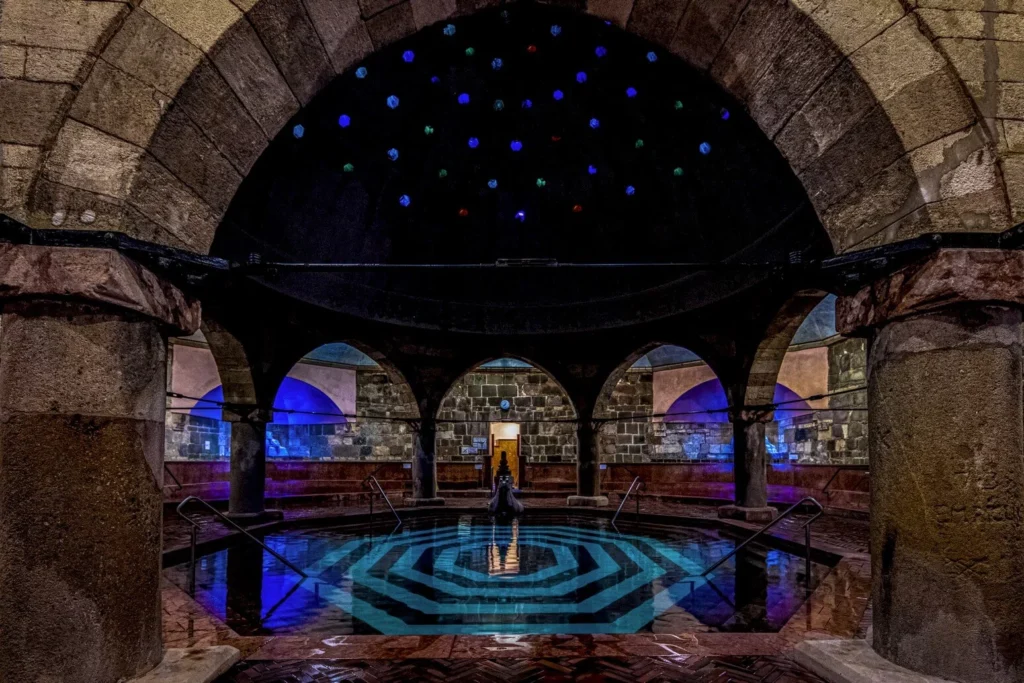
Photo by Rudas Bath Budapest
What stands out is how little the core experience has changed. You move through warm, mineral-rich water under stone domes that filter natural light in narrow beams. It feels enclosed but not heavy, structured but not rigid. These spaces were designed for ritual and rest, and that intention is still visible today.
The Golden Age of Grand Bath Architecture
The late 19th and early 20th century brought a very different layer. As Budapest developed into a major European capital, bathing culture became more formalized and architecturally expressive. This was the period when large public bath complexes were built, combining medical thinking, social life, and monumental design. One of the most recognizable examples is Széchenyi Thermal Bath. Located in City Park, it is one of the largest spa complexes in Europe. Its Neo-Baroque architecture, open-air pools, and symmetrical layout reflect a time when baths were seen not only as places of relaxation, but also as symbols of modern urban life.

Photo by Ladies What Travel
In contrast to the Ottoman baths, these newer complexes feel more open, more social, and more structured. You are not just entering a bathing space, but a carefully designed public environment where architecture plays as much of a role as the water itself.
Everyday Culture, Not Just Wellness
What separates Budapest from other spa cities is how naturally bathing fits into daily routines. It is not treated as a special occasion. Locals use thermal baths throughout the year, sometimes for relaxation, sometimes for health, sometimes just as a way to slow down.

Photo by Expedia
Different baths offer different experiences. Some are quiet and traditional, others are more lively and social. The variety means there is no single way to experience them. You choose based on mood, not obligation. Even smaller details matter. Morning visits feel different from evening ones. Winter bathing in outdoor pools, with steam rising into cold air, has become almost iconic. It is less about luxury and more about rhythm.
Architecture That Shapes the Experience
Unlike many wellness spaces elsewhere in Europe, Budapest’s baths are defined as much by architecture as by water. Domes, arches, courtyards, and open-air pools all shape how the experience feels. At Gellért Thermal Bath, for example, Art Nouveau interiors create a very different atmosphere compared to the Ottoman structures. Mosaic tiles, stained glass, and decorative columns turn the space into something closer to a historic hall than a modern spa. This architectural variety means that no two baths feel the same. The experience is not standardized. It changes depending on where you go, and that variation is part of what keeps the tradition alive.

Photo by Driftyland
A Culture That Never Really Stopped
Unlike many spa traditions in Europe that faded and were later revived, Budapest’s bathing culture has remained continuous. Even during political and social changes in the 20th century, the baths stayed in use. They adapted, but they did not disappear. This continuity is important. It means that when you enter a thermal bath in Budapest today, you are stepping into a practice that has been evolving in the same place for centuries, without interruption.
Why Budapest Still Holds This Identity
Budapest did not become the spa capital of Europe through branding or reinvention. It became one through geography and history, then kept it through consistency. The natural springs were always there. The architecture developed around them. The culture grew into them.
And today, that combination still defines the city. You can walk through grand boulevards, cross historic bridges, and end the day in a steaming outdoor pool without ever leaving the same urban system. That is what makes Budapest’s spa identity different. It is not a separate layer of the city. It is part of how the city functions, quietly running beneath everything else, always present, always accessible, and still very much in use.