













Budapest in the 1900’s vs nowadays
At the beginning of the 20th century, Budapest was already becoming the city we recognize today. The Millennium celebrations of 1896 had transformed the capital, bringing new confidence, grand public buildings, improved transport, and some of the most ambitious architectural projects of the era.
Nowadays photo by @norbertlepsik – photo from the 1900’s from fortepan’s archive
But the Budapest of the early 1900s was still a work in progress. Some of the landmarks that now define the skyline did not exist yet, while others looked completely different. Bridges had different structures, squares had different layouts, and the Castle District carried another silhouette. What makes Budapest so fascinating is that the city never stopped changing. Some buildings disappeared, some were rebuilt, and others survived with their original character still visible. The result is a place where the past is not separated from the present, but constantly appears in everyday views.
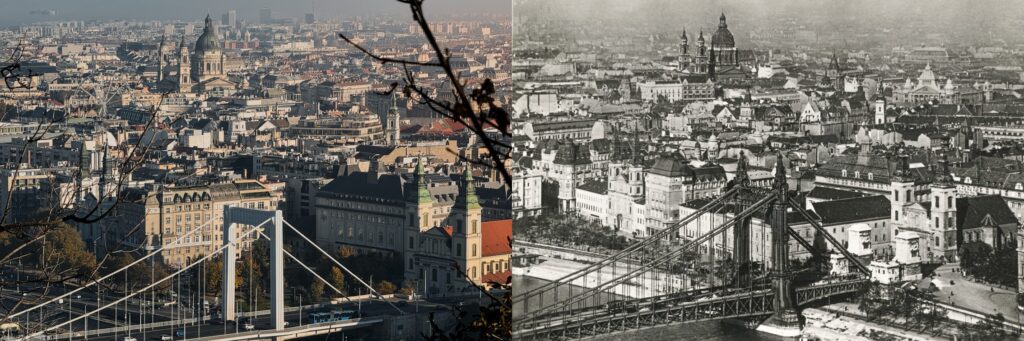
Elizabeth Bridge, Then and Now
The original Elizabeth Bridge (Erzsébet híd) opened in 1903 and quickly became one of Budapest’s most elegant crossings over the Danube. At the time, its white steel structure was considered one of the most impressive suspension bridges in the world, connecting the Buda and Pest sides with a design that matched the confidence of the era. That version of the bridge, however, did not survive the events of World War II. Like many of Budapest’s river crossings, it was destroyed during the fighting, leaving only memories and photographs behind.
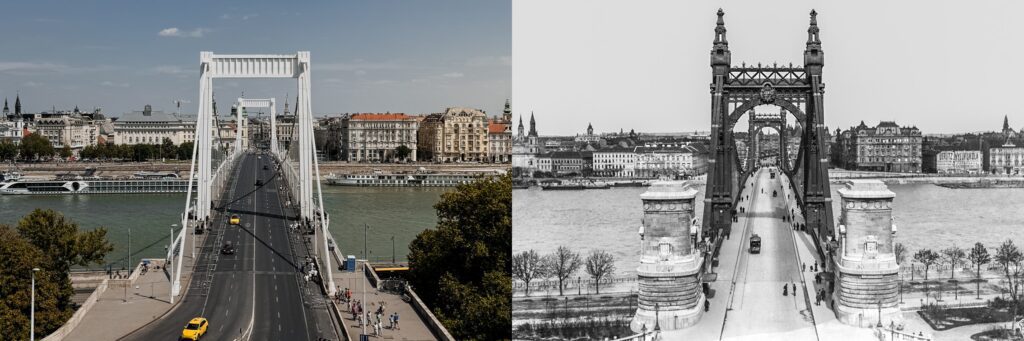
Nowadays photo by @norbertlepsik – photo from the 1900’s from fortepan’s archive
The bridge standing today was opened in 1964, keeping the same important connection between the two sides of the city but with a completely different architectural identity. The lighter, more modern structure reflects a very different period of Budapest’s history. The role remained the same, though. More than a century later, it still connects Buda and Pest, carrying daily life across the river.

Nowadays photo by @norbertlepsik – photo from the 1900’s from fortepan’s archive
Chain Bridge and the Changing City Around It
The area around Chain Bridge (Széchenyi Lánchíd) looked very different at the beginning of the 1900s. Captured from Clark Ádám Square, the scene shows a city still adapting to its new scale after the Millennium period. The bridge itself was already an established symbol, but the streets around it were still evolving. Tram infrastructure was expanding rapidly, becoming a key part of Budapest’s modernization. The first tram services on the Buda embankment north of Chain Bridge began in 1896, and over the following years the network continued to grow, connecting more parts of the city.
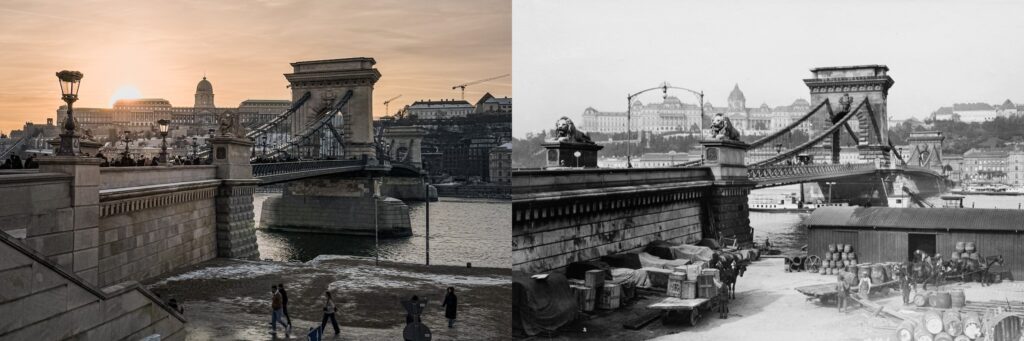
Nowadays photo by @norbertlepsik – photo from the 1900’s from fortepan’s archive
By 1907, new transport solutions around the Buda bridgehead helped integrate the area further into the expanding tram system. What seems like a simple street scene today was actually part of a much larger transformation, as Budapest adjusted to becoming a modern capital. The bridge stayed, the surroundings changed, and the city continued building around it.
Ferenciek tere Before the Modern City Rhythm
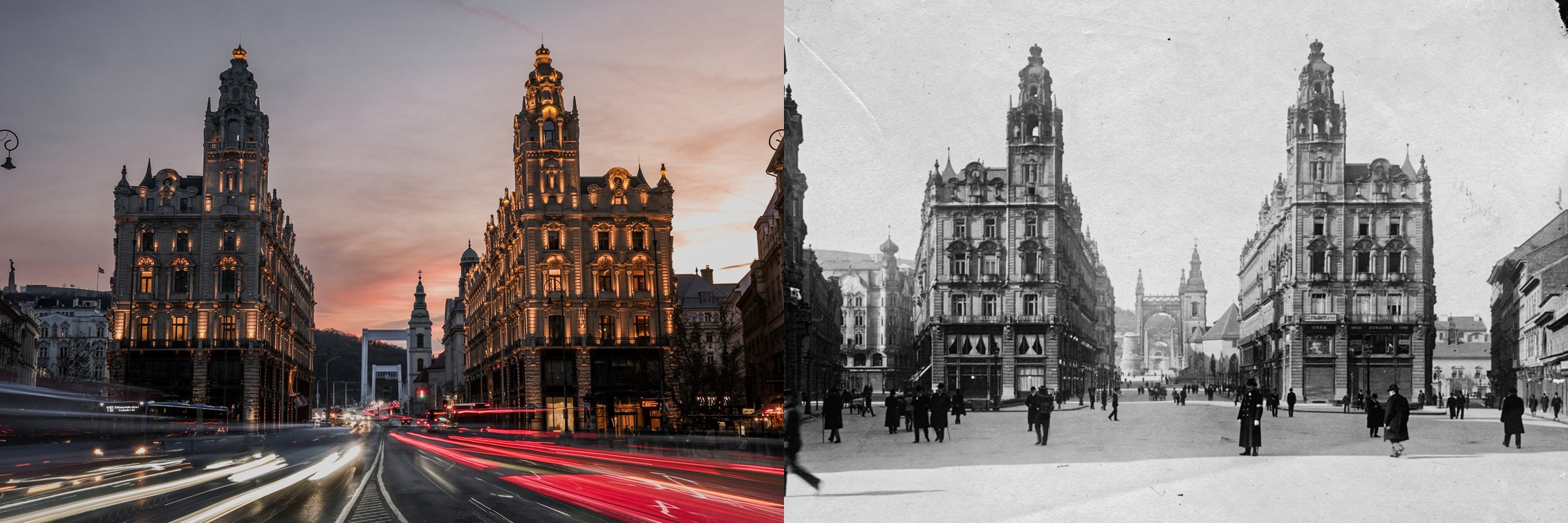
Ferenciek tere is one of those places where the past is still visible in every direction, but old photographs reveal a surprisingly different atmosphere. Without the usual traffic and movement of today, the square feels almost unfamiliar. The buildings become the main focus, especially the Matild and Klotild Palaces, completed between 1899 and 1902. Designed by Flóris Korb and Kálmán Giergl, the twin buildings became one of the defining architectural entrances to Budapest’s inner city.

Nowadays photo by @norbertlepsik – photo from the 1900’s from fortepan’s archive
Their design reflects the character of the period, mixing eclectic influences with the decorative details that were becoming increasingly popular around the turn of the century. Neo-Baroque forms, rich ornamentation, and early Art Nouveau touches all appear together. Today, the square is one of the busiest points in the city. But these older views show another side of it, a place where the architecture itself had more space to take the spotlight.
Buda Castle Before Its Transformation
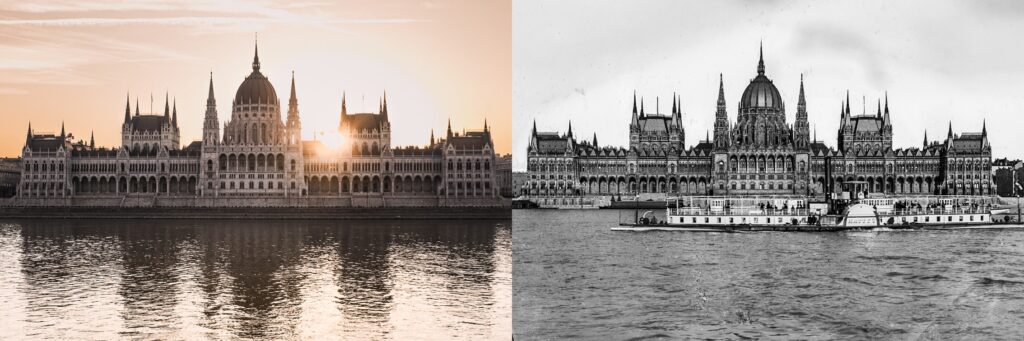
Few places in Budapest have changed as dramatically as Buda Castle (Budavári Palota). Seen from the opposite side of the Danube, the early 20th century silhouette shows a much more detailed and decorated version of the complex. The castle suffered heavy damage during World War II, and the later reconstruction significantly changed its appearance. Many historic interiors, decorative elements, and parts of the original roofscape were lost during the process.
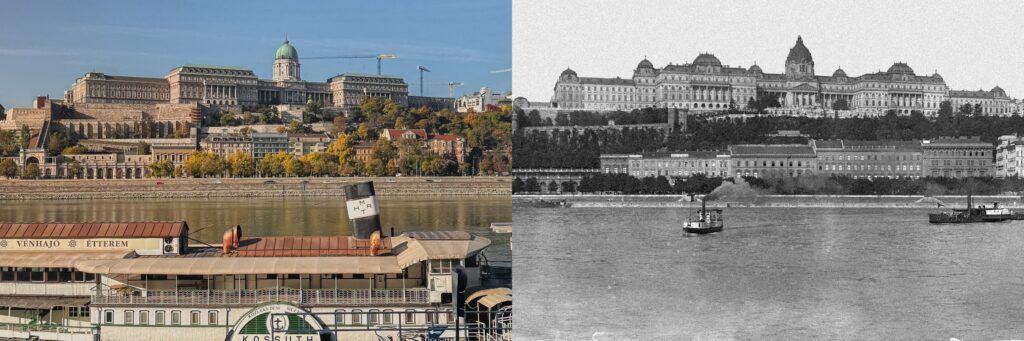
Nowadays photo by @norbertlepsik – photo from the 1900’s from fortepan’s archive
The result is the castle we know today, still monumental above the river, but visually different from its pre-war form. It remains one of Budapest’s strongest landmarks, not only because of what survived, but also because of the layers of history visible in its current appearance. It is a reminder that some of Budapest’s most familiar views are actually the result of many different eras meeting in one place.
Fisherman’s Bastion and a New View of Buda
Unlike some landmarks that changed dramatically, Fisherman’s Bastion (Halászbástya) is one of the places that still carries the atmosphere of the era that created it. Built between 1895 and 1905 as part of the wider renewal of the Castle District, the structure was designed by Frigyes Schulek to create a worthy setting around the restored Matthias Church. Its Neo-Romanesque arches, towers, and terraces were not built as a defensive fortress, but as a new architectural frame for one of Budapest’s most historic areas.
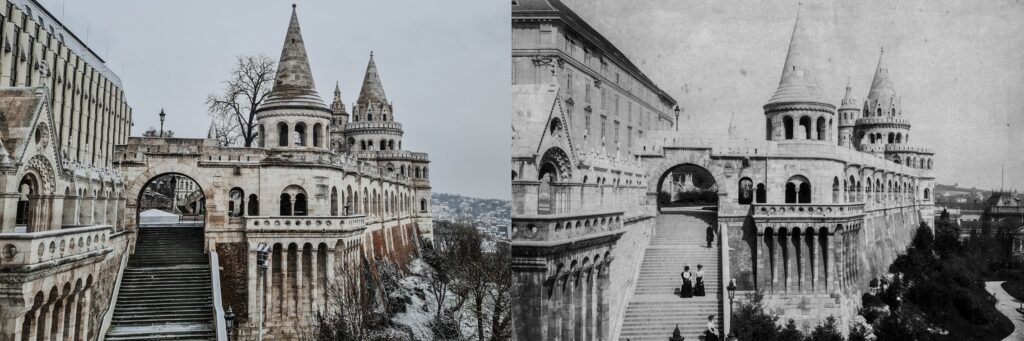
Nowadays photo by @norbertlepsik – photo from the 1900’s from fortepan’s archive
The project was connected to the Millennium celebrations and the idea of presenting Buda Castle as a symbol of Hungarian history. Construction began in 1899 and continued in stages until the complex was completed. Today, the terraces remain one of the city’s most recognizable viewpoints, offering the same reason they were created for over a century ago, a place to look across the Danube and understand the relationship between Buda and Pest.
A City That Keeps Moving Forward
Comparing Budapest from the early 1900s with the city today shows just how much can change while the character remains. Bridges are rebuilt, transport networks expand, buildings are restored, and entire neighbourhoods evolve. Yet the core identity of Budapest remains connected to the city that was created during its great transformation at the turn of the century.
Nowadays photo by @norbertlepsik – photo from the 1900’s from fortepan’s archive
That is what makes these old photographs so interesting. They do not show a lost city. They show an earlier chapter of the same one. A city that keeps changing, while still carrying its past into the present.

Nowadays photo by @norbertlepsik – photo from the 1900’s from fortepan’s archive